
How Communication Prevents Conflict: Techniques That Work
- William DeMuth

- Jun 20
- 6 min read

Effective communication is the single most reliable tool for preventing conflict from escalating into violence. When people express themselves clearly, listen with genuine attention, and manage their emotional responses, disputes stay manageable. When those skills break down, tensions rise fast. The role of communication in conflict prevention spans everything from how a first responder approaches a volatile situation to how a community organization structures a difficult conversation between neighbors. The core elements are consistent: active listening, empathy, emotional regulation, nonverbal awareness, and responsive rather than reactive language.
CVPSD, a 501©(3) nonprofit, grounds its crisis intervention and de-escalation training in evidence-based research, equipping individuals and organizations with these exact skills. Key communication principles for violence prevention include:
Active listening to fully understand the other person’s perspective before responding
Empathy and perspective-taking to reduce defensiveness and build trust
Emotional regulation to prevent physiological stress from derailing productive dialogue
Nonverbal alignment so body language and tone reinforce, not contradict, verbal messages
Responsive communication that pauses before reacting and focuses on solutions
Conflict-sensitive messaging that avoids triggering further tension in volatile environments
Politeness and courtesy as a consistent, practical de-escalation habit
Table of Contents
How facilitated dialogue works as a conflict intervention
Facilitated dialogue is a structured communication process that brings conflicting parties together under a neutral facilitator to express, listen to, and explore diverse perspectives. Its goal is not necessarily agreement. It is mutual understanding, which creates the conditions for lasting peace.
Over the past 25 years, facilitated dialogue has been a core tool in peacebuilding programs worldwide, used at every level from local community disputes to national policy conflicts. Research from the United States Institute of Peace confirms that dialogue reduces violent conflict and builds the underlying conditions necessary for peace. The process works by transforming individual, relational, and structural drivers of conflict through structured communication rather than confrontation.
Key features of effective facilitated dialogue include:
A neutral facilitator who manages power dynamics and keeps the process safe
Structured turns for speaking and listening, so all voices are heard
A focus on underlying needs and interests, not just stated positions
Graduated stages moving from understanding to joint problem-solving
Sustained engagement over time, not a single session
Authentic dialogue must be resilient enough to withstand hard truths and genuine emotional expression. That resilience is what makes it effective for lasting change, not just temporary calm.
How to manage emotional escalation during conflict
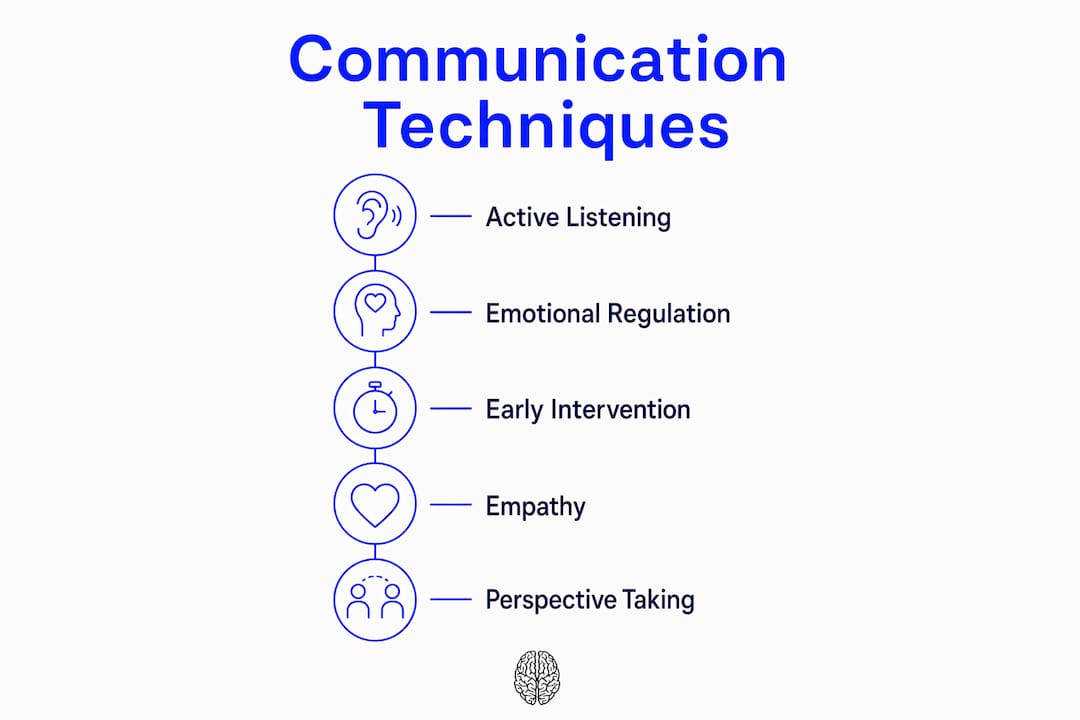
The body’s stress response is one of the biggest obstacles to productive communication. When conflict intensifies, physiological emotional flooding impairs reasoning and makes constructive dialogue nearly impossible. Taking a break of at least 20 minutes during an escalating conflict is one of the most effective repair techniques available, giving the nervous system time to return to a state where clear thinking is possible.
Reactive communication, arguing to win rather than to understand, consistently worsens conflict. Responsive communication requires a deliberate pause, a shift in focus from winning to understanding. That distinction changes outcomes.
Practical techniques for managing emotional escalation:
Take a minimum 20-minute break when emotional flooding begins
Use “I” statements (“I feel overlooked when decisions are made without me”) rather than “you” accusations
Speak calmly and maintain open, relaxed body posture
Paraphrase what the other person said before responding to confirm understanding
Focus on one issue at a time rather than stacking grievances
Recognize the four communication patterns that kill dialogue: criticism, contempt, defensiveness, and stonewalling
Pro Tip: A calm, quiet voice carries more authority in a tense situation than raised volume. Lowering your tone signals control, not weakness, and often prompts the other person to mirror it.
Verbal de-escalation strategies trained by CVPSD build directly on these principles, giving practitioners a repeatable framework for high-pressure moments.
What conflict-sensitive communication means in practice
Conflict-sensitive communication means designing and delivering messages with a clear understanding of the social and political context in which they land. The guiding principle is “Do No Harm”: communicators must avoid inadvertently reinforcing tensions, spreading disinformation, or triggering defensive reactions in already volatile environments.
Adhering to Do No Harm principles reduces escalation risks by requiring communicators to understand who they are, how their positionality shapes their message, and how that message will be received by different audiences. Strategic communication in peacebuilding also shapes perceptions and fosters participation in ways that either support or undermine conflict prevention.
Best practices for conflict-sensitive messaging:
Analyze the conflict context before communicating, including who holds power and who is vulnerable
Avoid language that assigns collective blame or reinforces us-versus-them narratives
Counter hate speech and disinformation with accurate, respectful, and timely information
Tailor messages to the specific audience, recognizing cultural and historical sensitivities
Foster solidarity and constructive narratives rather than fear or division
Monitor how messages land and adapt when unintended harm occurs
Why politeness and courtesy prevent conflict from starting
Polite, courteous communication reduces defensiveness before it has a chance to build. When people feel respected, they are far more likely to stay open to what is being said, even when the content is difficult. Courtesy is not about avoiding hard conversations. It is about creating the conditions in which hard conversations can actually happen.
Nonverbal cues like posture, eye contact, and nodding significantly influence whether a conversation feels safe or threatening. Aligning body language with verbal messages prevents mixed signals that breed confusion and resentment. A person who says “I hear you” while crossing their arms and looking away sends a contradictory message that erodes trust immediately.
Communication habits that build courtesy in high-tension settings:
Start conversations with something positive or an expression of appreciation
Use “I” statements consistently to express concerns without assigning blame
Make and receive repair attempts, small gestures that signal a willingness to de-escalate
Maintain eye contact and an open posture to signal genuine engagement
Validate the other person’s feelings even when you disagree with their position
Keep statements short and clear to avoid overwhelming the listener
CVPSD’s training programs emphasize these habits as foundational, not supplementary, to effective conflict resolution communication.
How catching misunderstandings early prevents escalation
Most conflicts do not begin with a major grievance. They begin with a small misunderstanding that goes unaddressed. Left alone, that misunderstanding grows, assumptions harden, and what could have been a brief clarifying conversation becomes a serious dispute.
Effective communication is not about suppressing emotions but about addressing differences constructively before they compound. Early identification requires paying attention to shifts in tone, body language, and engagement. When someone becomes quieter, shorter in their responses, or visibly tense, those are signals worth addressing directly and gently.
Practical steps for catching misunderstandings early:
Ask clarifying questions rather than assuming intent (“Can you help me understand what you meant by that?”)
Discuss backgrounds and perceptions openly to surface differing expectations
Paraphrase what you heard and invite correction before moving forward
Address tension as soon as it appears rather than waiting for a formal conflict
Create regular, low-stakes check-ins in organizational settings to surface friction before it escalates
Understanding the conflict spectrum helps practitioners recognize which stage a dispute has reached and respond with the right level of intervention.
Why empathy and perspective-taking change conflict outcomes
Empathy is the capacity to understand another person’s experience from their point of view, not just to acknowledge that their experience exists. In conflict prevention, it is one of the most powerful tools available because it interrupts the cycle of reactive opposition.

Research on communication during conflict shows that direct opposition can motivate change when serious problems need to be addressed and the other person is capable of being responsive. But when defensiveness is high, a softer approach that leads with empathy and validation tends to produce better outcomes. Knowing which mode to use requires reading the other person accurately, which is itself an empathy skill.
Perspective-taking goes one step further. It asks you to actively consider why the other person holds their position, what fears or needs underlie it, and what a resolution that respects those needs might look like. Dialogue that incorporates this kind of mutual understanding consistently produces more durable agreements than dialogue focused solely on positions.
CVPSD’s evidence-based training builds empathy and perspective-taking as core competencies for anyone working in violence prevention or crisis intervention, because these skills do not develop reliably without deliberate practice.
Key Takeaways
Communication prevents conflict by enabling early intervention, emotional regulation, and mutual understanding before tensions reach a breaking point.
Point | Details |
Take breaks during escalation | Taking a sufficient break reduces physiological flooding and restores the capacity for productive dialogue. |
Use responsive, not reactive, communication | Pausing before responding and focusing on understanding rather than winning consistently reduces conflict severity. |
Apply the Do No Harm principle | Conflict-sensitive messaging requires understanding context and avoiding language that reinforces division or triggers defensiveness. |
Catch misunderstandings early | Addressing small tensions through clarifying questions prevents them from hardening into serious disputes. |
Build empathy as a practiced skill | Perspective-taking and empathic acknowledgment change conflict outcomes, especially when defensiveness is high. |
Recommended


