
5 Screening Questions, Models & Scripts for Crisis Practitioners

Crisis intervention is rapid, time-limited support aimed at stabilizing immediate danger and restoring a person’s ability to cope. The first priority is always safety: assess for lethality, establish rapport quickly, calm acute distress, and build a short plan or refer to the next level of care. What follows are the exact scripts, assessment questions, and models that turn that sequence into practice.
Executive Summary
Rapid crisis intervention relies on active listening, emotion validation, and short-term goal setting, with a focus on immediate safety and stabilization.
Using adaptable models like Gilliland’s Six-Step, Roberts’ Seven-Stage, SAFER-R, or Psychological First Aid depends on the setting’s time frame and resource availability.
Safety screening must be direct and specific, focusing on intent, plan, means, timeline, and history, with urgent escalation if active lethal behavior is identified.
De-escalation hinges on calm tone, open body language, environmental control, and a trauma-informed approach that respects cultural differences.
Crisis plans should be concise, include warning signs, coping strategies, support contacts, means restriction, and clear follow-up goals, with documentation shared across providers.
Table of Contents
Core Crisis Intervention Techniques for Rapid Stabilization
The techniques that matter most in an acute crisis are not complicated. They are simple skills executed under pressure, in the right order, without shortcuts.
Active listening comes first, and it means more than nodding along. It requires reflecting content, naming emotion, and checking your understanding out loud. A few phrases do most of the work:
“So what you’re telling me is…” (reflects content)
“It sounds like you’re feeling trapped right now.” (names emotion)
“Did I get that right, or am I missing something?” (checks accuracy)
These aren’t scripts to recite mechanically. They’re structures you fill with the person’s own words, which is what makes someone in crisis feel heard rather than processed. CVPSD’s training on active listening draws a sharp line between listening to respond and listening to understand, and that distinction changes how a conversation moves in the first five minutes.
Question sequencing matters as much as question content. Start open (“Tell me what happened”) to let the person set the frame and reveal what matters to them. Narrow to focused questions (“When did you start feeling this way?”) once you have a general shape. Finish with closed questions (“Do you have access to a weapon right now?”) when you need a specific fact for a safety decision. Reversing that order, leading with closed questions, tends to shut a person down before they’ve told you anything useful.
Affective techniques work alongside listening. Validating confirms the emotion makes sense given the circumstances, without necessarily agreeing with the person’s interpretation of events. Normalizing frames the reaction as understandable rather than pathological (“A lot of people would feel overwhelmed after a week like that”). Containment means keeping the emotional intensity from escalating further, often just by staying calm and not matching the person’s volume or pace.
Once the acute emotional charge has dropped even slightly, solution-focused work becomes possible. This is where you help the person generate two or three concrete options instead of one impossible task. Effective crisis workers pair this with SMART short-term goals: specific, measurable, achievable, relevant, and time-bound. “Get better” is not a goal. “Call your sister tonight and tell her how you’re feeling” is. Clinical guidance on psychosocial crisis management links this kind of structured, solution-focused approach to reduced short-term symptoms and fewer repeat emergency visits.
It helps to know the boundaries of what a single session can accomplish. Crisis intervention is not therapy. Most models are designed for use within four to six weeks of the triggering event, and a single contact often lasts somewhere between 20 minutes and an hour. The goal is stabilization and a bridge to further care, not resolution of underlying issues.
Pro Tip: When a person can’t generate their own coping strategies, don’t wait for inspiration to strike. Offer two or three low-effort, trialable options on the spot, like a breathing exercise, a grounding technique, or one specific person to text, and set a follow-up check within 24 to 72 hours. That short window is what keeps someone from falling through the cracks between your conversation and their next appointment.
Which Crisis Intervention Model Should You Use?
Several named frameworks structure how professionals move through a crisis contact, and each fits a slightly different setting. Knowing the differences lets you pick the right one on the fly instead of improvising.
Gilliland’s Six-Step Model organizes work into listening (defining the problem, ensuring safety, providing support) and acting (examining alternatives, making plans, obtaining commitment). It’s built for flexibility, which makes it a strong default for generalist settings like schools, community agencies, and outpatient clinics where you might only get one contact.
Roberts’ Seven-Stage Model extends that logic with more granularity: plan and conduct a biopsychosocial assessment, rapidly establish rapport, identify major problems, deal with feelings, generate and explore alternatives, implement an action plan, and follow up. Both frameworks are widely used clinical structures that move through the same core arc: assessment, rapport, problem exploration, action plan, follow-up. Roberts’ model tends to suit settings with more time and continuity, like hospital-based crisis teams or behavioral health intake units, where a follow-up contact is realistically going to happen.
SAFER-R compresses the process into five moves: stabilize, acknowledge, facilitate understanding, encourage effective coping, and refer for follow-up. It was built for rapid, non-clinical response, which makes it the right fit for first responders, workplace incident response teams, and school staff who need something usable without years of clinical training behind it. SAFER-R and Psychological First Aid are the two frameworks most often recommended for exactly this kind of rapid, non-clinical response.
Psychological First Aid (PFA) skips formal diagnosis entirely and focuses on immediate comfort, safety, and connecting people to resources. It was designed for mass-casualty and disaster response, but it works just as well for a single overwhelmed employee or a distressed caller on a helpline.
Here’s how they line up by setting:
Model | Best-fit setting | Core strength |
Gilliland’s Six-Step | Schools, community agencies, single-contact situations | Flexible, adaptable sequencing |
Roberts’ Seven-Stage | Hospitals, behavioral health intake, ongoing care | Depth and structured follow-up |
SAFER-R | First responders, workplaces, rapid triage | Speed, minimal training required |
Psychological First Aid | Hotlines, disaster response, mass-casualty events | Non-clinical, immediate comfort |
In practice, most experienced crisis workers blend elements. A hotline volunteer might open with PFA’s immediate stabilization, then borrow Gilliland’s alternative-generation step once the person has calmed down. A hospital social worker might run a full Roberts assessment but compress stages three and four when time is short. Sequencing should adapt to the setting: triage contexts call for compression, while extended relationships call for the fuller versions of these models.
Cultural context changes how each model plays out, too. Direct questioning that works in one community may read as intrusive or disrespectful in another. Adjust pacing, involve trusted family or community members where appropriate, and never assume the sequence has to happen in one sitting just because the model lists it in order.
How Do You Screen for Suicide and Violence Risk Fast?
Every crisis contact starts with a safety check, and it has to happen before anything else, including rapport-building, if there’s any sign of imminent danger.
Five things need a quick answer, in this order:
Intent. Does the person want to die or hurt someone, or are they describing distress without that specific intent?
Plan. Have they thought through how they would do it?
Means. Do they have access to what the plan requires, right now?
Timeline. Is this an immediate risk (today, tonight) or a more distant one?
History. Have they attempted or acted on this before?
Vague questions get vague, unreliable answers. Direct, time-specific phrasing gets you the truth far more often. Ask something close to: “Have you had thoughts of killing yourself in the past 24 hours? Do you have a plan right now?” This kind of specific, time-bound phrasing consistently surfaces more accurate risk disclosure than a general “Are you okay?”
The same directness applies to violence risk toward others: “Have you thought about hurting [specific person]? Do you have access to a weapon?” Asking clearly does not plant the idea. Avoiding the question just means you’re making a safety decision with less information.
When to escalate immediately: call emergency services or arrange urgent evaluation the moment you hear an active plan combined with access to means and a timeline of hours rather than weeks. Waiting for more certainty at that point is not caution, it’s a delay with real consequences.
A few documentation and legal points matter here, even though they vary by jurisdiction and profession. Record what you asked, what the person said in their own words where possible, and what action you took. Duty-to-warn and mandatory reporting rules differ by state and by license type, so confirm your organization’s specific obligations rather than relying on general practice. When in doubt, consult a supervisor or your organization’s legal counsel before deciding not to escalate.
If the risk assessment comes back low, that doesn’t mean you’re done. It means you move into stabilization and planning with a baseline understanding of what’s actually at stake for this person, which is what the rest of the intervention builds on.
Verbal and Nonverbal De-escalation Techniques That Actually Work
Once safety is assessed and the immediate danger ruled out or managed, the next job is bringing down the emotional temperature. This is where tone, pacing, and body language carry more weight than the specific words you choose.
Opening lines matter because the first ten seconds set the frame for everything after. Try something low-pressure and non-confrontational:
“I’m here to help. Can you tell me what’s going on?”
“You seem really upset. I want to understand what’s happening.”
“I’m not going anywhere. Take your time.”
None of these demand information or challenge the person’s account. They signal presence without pressure, which is precisely what someone flooded with adrenaline needs before they can process anything else.
Voice matters more than most people expect. A calm, quiet voice carries more authority than an anxious torrent of instructions. Slow your speech rate below your instinct, drop your volume slightly rather than raising it to be heard, and leave pauses. Rushed, high-pitched speech reads as fear or urgency, and both are contagious in a room with someone already in crisis.
Body positioning should communicate safety, not control. Stand at an angle rather than squarely facing the person, which reads as less confrontational. Keep at least an arm’s length of distance, more if the person seems agitated. Keep your hands visible and open. Avoid pointing, crossed arms, or looming over someone who is seated.
Environment shapes outcomes as much as anything you say. Where you have any control over the physical space, dim harsh lighting if possible, remove obvious hazards or objects that could be used as weapons, and make sure you and the person both have a clear, unobstructed path to an exit. Sitting rather than standing often lowers tension automatically, and offering a seated option (without insisting) gives the person a sense of choice.
Common tips from established crisis-prevention trainers echo the same core moves: stay empathic, avoid judgmental language, set limits calmly rather than with a raised voice, and never mirror aggressive body language even when provoked. These foundational de-escalation principles hold up across settings, from psychiatric units to retail floors.
Pro Tip: If agitation is climbing despite your best efforts, the move is often to disengage and create space, not to push harder for connection. Say something like, “I’m going to give you a minute, and I’ll be right back,” and actually mean it. Forcing continued engagement with someone whose nervous system is in fight-or-flight rarely calms them down; it usually escalates further.
CVPSD’s verbal de-escalation training walks through these exact sequences with scenario practice, because reading a script and delivering it under real stress are two different skills entirely.
How Do You Build a Crisis Plan With Someone?
Once the acute intensity has come down, the work shifts from stabilization to planning. A brief, concrete plan gives the person something to hold onto after you’re gone, and it gives you a clear record of what happens next.
A short safety plan typically covers five elements:
Warning signs. What does this person notice in themselves right before things get worse? (racing thoughts, isolating, specific triggers)
Coping strategies. Two or three things they can do alone that have worked before, even partially.
Support contacts. Specific names and numbers, not “call someone.”
Means restriction. A concrete step to reduce access to whatever poses the highest risk, discussed collaboratively rather than dictated.
Professional and emergency contacts. Crisis line numbers, a named provider, and the nearest emergency department.
Set one SMART goal for the next 24 to 72 hours rather than a vague intention for the coming weeks. “Text your sponsor tonight before 9pm” beats “stay sober” because it’s specific enough to actually check on. Clinical guidance on brief crisis contacts recommends exactly this kind of short follow-up window to reduce the chance that someone abandons the plan before it takes hold.
Referral options depend heavily on severity and local resources. Mobile crisis teams can respond in person for situations that don’t require an emergency department but exceed what you can manage alone. Emergency departments remain the right call for active, high-lethality risk. Outpatient scheduling and peer support programs fit lower-acuity situations where the person mainly needs a next appointment and some continuity. SAMHSA’s national crisis care guidance outlines how these pathways are meant to connect, including helplines and mobile response standards that most regions now operate under.
Whatever plan you build, write it down in the person’s own words where you can, give them a copy, and communicate it to any other provider who needs to know. A plan that lives only in your notes doesn’t help the next person who picks up the case.
Trauma-Informed Practice, Cultural Sensitivity, and Protecting Yourself
Every technique above works better, and does less harm, when it’s delivered through a trauma-informed lens. That means treating safety, choice, and collaboration as non-negotiable rather than as a communication style you switch on when convenient.
In practice, trauma-informed principles look like:
Explaining what you’re doing and why before you do it, especially with physical proximity or documentation.
Offering choices wherever a choice genuinely exists, even something as small as where to sit.
Avoiding language that implies blame for the crisis itself.
Checking your own assumptions about what “calm” or “cooperative” should look like across different backgrounds.
Guideline summaries on trauma-informed crisis response consistently point to safety, collaboration, and empowerment as the three pillars that distinguish trauma-informed intervention from generic crisis response. Strength-based planning, building the plan around what the person has already managed to do rather than only what’s broken, tends to produce plans people actually follow.
Cultural humility means adjusting your approach without abandoning your assessment responsibilities. Eye contact norms, family involvement expectations, and comfort with direct emotional language vary widely, and a script that works with one person can misfire badly with another. The fix isn’t a checklist of cultural rules; it’s staying curious and asking rather than assuming.
Specialized crisis training turns a chaotic, high-stakes moment into a genuine opportunity for stabilization and longer-term healing, but only when technical skill is paired with real cultural sensitivity, not layered on top of it as an afterthought.
Self-care isn’t a footnote here. Responders who absorb crisis after crisis without structural support are at real risk of secondary trauma, and preventing it is an organizational responsibility, not just a personal one. Mandatory debriefs, peer support structures, and reasonable caseload limits matter more than individual resilience advice. CVPSD’s case study on staff safety and confidence documents how structured training and follow-up support measurably change how healthcare and human services staff handle repeated crisis exposure.
What Should You Do in the First 15 Minutes of a Crisis?
When you’re in the moment and don’t have time to think through models, run this sequence.
Assess safety first (0 to 2 minutes). Scan for weapons, exits, and immediate danger signs. Ask directly if there’s any indication of self-harm or harm to others.
Make contact calmly (2 to 4 minutes). Introduce yourself, lower your voice, and open with “I’m here to help. Can you tell me what’s happening?”
Listen and reflect (4 to 8 minutes). Use open questions first, then narrow. Reflect back what you hear: “It sounds like…”
Stabilize the emotion (8 to 12 minutes). Validate, normalize, and offer one concrete grounding option if distress is still high.
Set a next step (12 to 15 minutes). Agree on one specific action and, if needed, hand off: “I’m going to connect you with [mobile crisis team/on-call clinician] right now, and I’ll stay with you until they arrive.”
Stop and call for help immediately if at any point you hear an active plan with access to means, or if the person’s behavior suggests imminent danger to themselves or anyone nearby. No later step in this sequence outranks that call.
What Training Actually Changes in the Field
Two patterns show up constantly across the caregivers and clinical staff CVPSD trains. The first: people know the theory but freeze on the actual wording when someone in front of them is escalating. The second: teams skip the follow-up step entirely, treating stabilization as the finish line instead of the midpoint.
Scenario-based practice fixes both, because rehearsing the exact phrases under simulated pressure is what makes them available under real pressure. Training also changes documentation habits and referral confidence, not just the crisis moment itself.
Shawn Lebrock
How CVPSD Trains Teams to Handle Real Crises
CVPSD builds crisis intervention and de-escalation training around the setting you actually work in, not a one-size version borrowed from a different field. Healthcare teams get programs built around clinical handoffs and patient safety. Schools get age-appropriate de-escalation and staff response protocols. Corporate and nonprofit teams get workplace-specific scenario training that matches their actual risk profile.
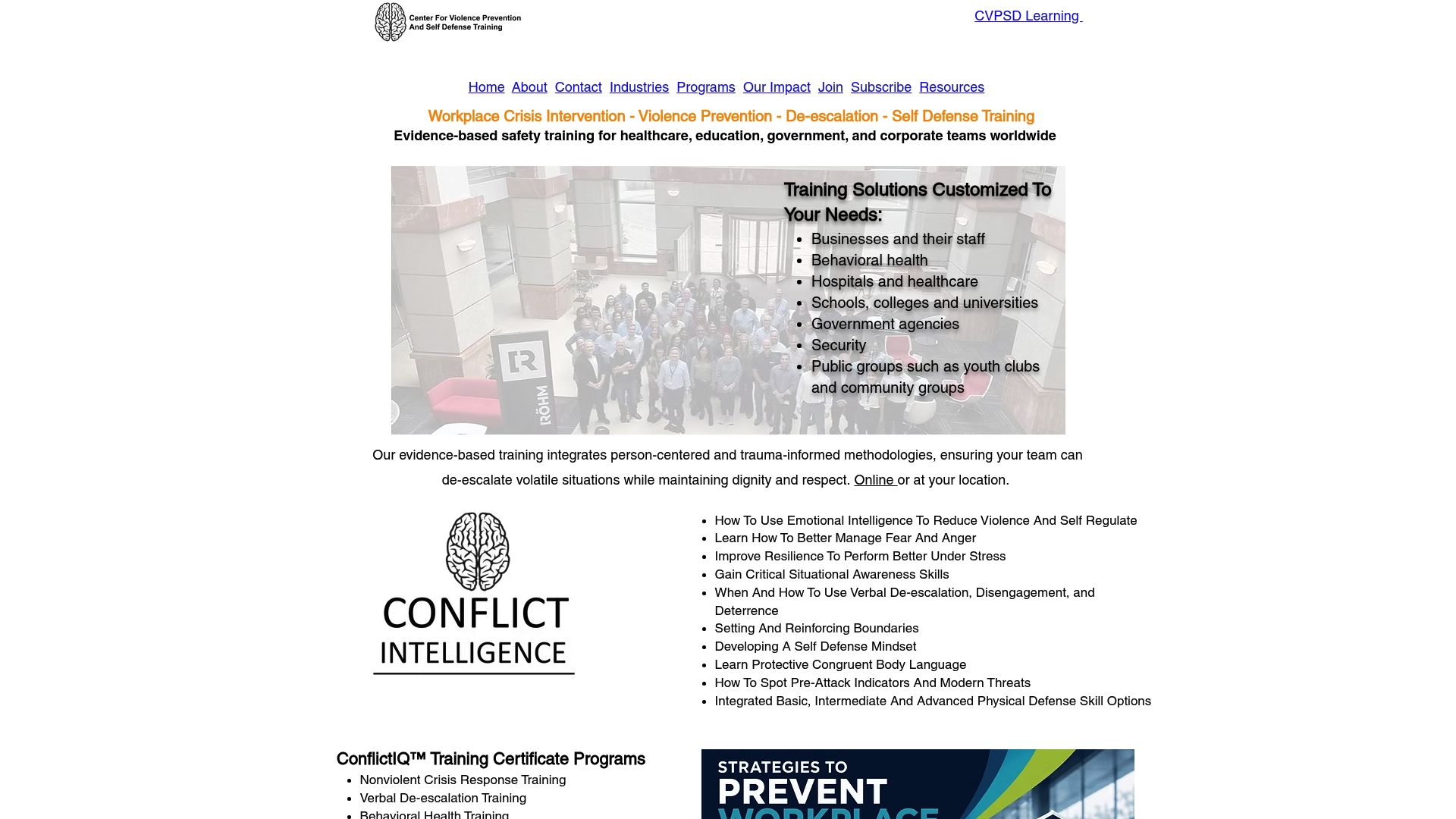
Every CVPSD program is delivered in-person or online, and every learner leaves with usable templates, not just concepts: safety-plan formats, assessment scripts, and de-escalation phrasing they can adapt on the spot. Organizations that need internal capacity can pursue train-the-trainer certification, which builds a in-house team that can keep training current staff without repeating the full engagement every time. Programs are structured to meet state and local requirements, so compliance isn’t an afterthought bolted onto the curriculum. If your team needs a crisis response protocol that actually holds up under real conditions, visit CVPSD’s program page to review current offerings and request a consultation for your organization.
This article is general information, not a substitute for advice from a qualified doctor. Consult a qualified healthcare professional about your own circumstances before acting on anything here.
Sources
FAQ
What Are the Core Crisis Intervention Techniques?
The core techniques are active listening, affective work like validating and containing emotion, and solution-focused planning built around SMART short-term goals within a brief, time-limited contact.
What Is the Difference Between Gilliland’s and Roberts’ Models?
Gilliland’s Six-Step Model is a flexible, generalist framework suited to single-contact settings, while Roberts’ Seven-Stage Model adds more assessment depth and structured follow-up for settings like hospitals and behavioral health intake.
What Is SAFER-R Used For?
SAFER-R (stabilize, acknowledge, facilitate understanding, encourage effective coping, refer) is built for rapid, non-clinical response in settings like workplaces, schools, and first-responder teams.
How Do You Ask About Suicide Risk Safely?
Ask direct, time-specific questions such as “Have you had thoughts of killing yourself in the past 24 hours? Do you have a plan right now?” since vague questions produce less reliable answers.
Does CVPSD Offer Crisis Intervention Training for Organizations?
Yes. CVPSD delivers in-person and online crisis intervention and de-escalation programs tailored to healthcare, education, corporate, nonprofit, and government settings, including train-the-trainer certification.
Recommended
Crisis De-escalation Guide: Recognizing Behavior Levels and the Right Staff Response at Each Stage
Behavioral Health Crisis Response Training for Organizations
Crisis Communication Training Series: Verbal Behavior, Nonverbal Behavior, and Body Language
CIT Training Explained: How to Choose the Right Crisis Intervention Training Program by Risk Level
About the Author: William DeMuth is the Director of Training at the Center for Violence Prevention and Self Defense (CVPSD) in Freehold, NJ. With over 35 years of research in violence dynamics and personal safety, William specializes in evidence-based training that bridges the gap between compliance and real-world conflict resolution. The architect of the ConflictIQ™ program, he holds advanced certifications and has trained under diverse industry leaders. Today, he actively trains civilians, hea


